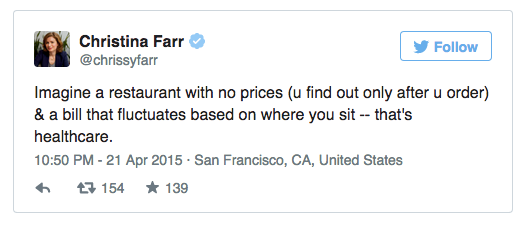

You call for an appointment and are told it will be about 20 days.
You arrive on time only to sit in the apt named waiting room for 40 minutes.
You see your primary care doctor (PCP).
You start to explain why you came in.
You call for an appointment and are told it will be about 20 days.
You arrive on time only to sit in the apt named waiting room for 40 minutes.
You see your primary care doctor (PCP).
You start to explain why you came in.
Transitioning from insurance-based care into Direct Care isn’t a walk in the park. Cutting the red tape is not necessarily about EASE.
It’s about AFFECT. Affecting patients lives, affecting our own lives as doctors and business owners. It’s about having a stake in the work we do, and being rewarded for doing it well.
Here’s an earnest email from Mary Wulfers. She’s helping her husband run his newly opened Direct Care practice.
We’re really busy. Mike has about 130 new patients and they all seem to want a physical right away, so he’s really really busy. Around 170-180 patients transferred from his old practice, and we’ve obtained and built all those charts as well. I continue to work full time at the office and then some out of necessity, which is just fine. Younger families are really starting to sign up; it’s almost like the word has just gotten out. Last Monday was quite a day, had 17 new patients sign up and our nurse was out sick that day, too.This has been a very rewarding experience in so many ways but a lot of work, too. Out [sic] new website should be online soon, can’t wait to see it. Mike is really happy about some of the new patients he’s getting, some with poor insurance who are so excited to have a good doctor for the first time. How can you beat that?
Seriously, how CAN you beat that?
Do you believe in the power of Atlas MD-style direct care to address our ailing healthcare system? Affordable subscriptions, unlimited visits, 24/7 doctor access, wholesale prescriptions — some as low as pennies per pill — and discounted labs, and the reality of switching to a wrap-around insurance plan… Then take the CMT survey here.
Dr. Brian McDonough, Medical Editor of CBS Philadelphia, made a sad recommendation when he said, “Next time you see your doctor you might want to ask if he or she is happy.” Ouch. According to a study last year, 42% of docs admit they are ‘dissatisfied’ or ‘very dissatisfied’ in their medical practices, and 59% say they are unlikely to encourage a young person to go into medicine (talk about exacerbating the doctor shortage). Compare that with only 16% of physicians reporting a generally favorable outlook about their career future. Read more
Brian Gans is seeing family medicine in a new light. He shared his passion for direct primary care in a new blog post that’s making the rounds in our online community. This first sentence is simply prophetic. Brian writes, “When I first entered medical school, I was very attracted to family medicine as a discipline, but I wasn’t attracted to practicing in a model that limited me to less than 15 minutes of face time per patient…”
Seriously, how can we expect our nation’s current, and widening, doctor shortage to be abated when students are confronted with the grim reality of hamster wheel medicine? And don’t forget the red tape. It’s sticky, and will require the majority of med student’s future to offset. Brian, like many students, is aware that fee-for-service medicine requires 45 minutes of paperwork to get reimbursed for every 15 minutes of work. There’s little to no room for innovation in this type of environment.
We’re blessed to have been the thesis of Sam Jordan’s academic paper, “Medicine Shrugged.” Originally from Salina, Kansas, she’s now a freshman at George Mason University in Fairfax, Virginia and is majoring in Economics. She included email correspondences with Dr. Josh as part of her sources to build a case for free market medicine. Texts from Ayn Rand, Alan Greenspan and other intellectuals were cited alongside our personal experience.
Thanks to Sam, for letting us share her work with our supporters. We have to admit, we blushed when she compared us to Aluminum Company of America. ALCOA is known for its shining example of profit-maximization and price-minimization in Greenspan’s paper, “Trust.” It serves as a concise way of understanding our mission to cut the red tape. And yes, it’s true: we’re motivated to offer the best healthcare while making the most money possible. Sam had no hesitation in addressing that.
We’ve included the complete work below. Take a look. And if you’re interested in a digital copy of Sam’s paper, send us a line at hello[at]atlas.md …
You know our style. We’re opinionated folks here. We speak liberally about the red tape that bloats healthcare costs—absurd ER charges for one. You’ve heard our spiel: We insist that affordable primary care like what we offer at Atlas MD can keep people out of the ER, and save everyone (patients’ wallets, insurance companies’ payouts, frazzled doctors’ sanity, even our nation’s budget) considerably.
Speaking of costly ER charges, NPR just wrote another piece about the topic. It’s also Dutch-related, and definitely worth checking out.
NPR writes, “In the United States, the growing number of uninsured Americans means more people do not have a family doctor or primary care provider. When they suffer a worrisome accident or problem, they may end up in the nearest hospital emergency room.”
And this is where we as a nation are just pouring money down the drain.
Drs. Josh and Doug demonstrate the Calendar feature of Atlas.md. Set appointments and reminders, and sync them with your devices.
VIEW ALL ATLAS.MD EMR TUTORIAL VIDEOS
Have more questions about Atlas.md? Send them to hello[at]atlas.md …
Want to try Atlas.md EMR? Sign up for free at Atlas.md/signup.
And we’re back. You can stream the new Atlas MD podcast on iTunes. We’ve had some recent speaking engagements, one of which was with the Wichita Rotary. Little known fact, our local Rotary Club is the seventeenth largest in the world! Who’d have thought?
Also, thanks Dr. Ray Siedel from Ruidoso, New Mexico, who stopped in to discuss his direct care transition that’s happening over the next six weeks. We have multiple doctors scheduled to come in every week for the next month. We’re always glad to talk shop, so let us know if you want to stop in.